Showing posts with label Judy Chicago. Show all posts

Sunday, August 16, 2009

Seeing Judy Chicago's The Dinner Party at the Brooklyn Museum


Getting to see Judy Chicago's masterwork, The Dinner Party, was nothing short of a life dream come true. My well-thumbed copies of Chicago's books about the project were my sole connection with it, and they had a profound influence on me as an artist. They made me believe that I could make art as a quilter. Through Judy Chicago's website, I had been following the effort to find a permanent home for her work which finally happened at the Brooklyn Museum. Having four days in New York City meant that I would finally have time to make the pilgrimage.

The New York subway system has improved immeasureably since the 1970's when I lived in Manhattan. I walked and got very good on the buses back then just to avoid having to make the trek underground into those dark, dirty, unsafe trains. Now, what a difference! We were staying in Times Square and I got a clean, well-lighted, air conditioned train directly to the museum in that station. This is also a good time to mention that the Brooklyn Museum is the best-kept secret in New York City. It has a collection that rivals the Met, but without the crowds. I visited on a weekday and was alone in the Dinner Party exhibit for almost 45 minutes.

Unfortunately, as with most museums, photography is not allowed, so you will have to make use of the links to check out the work itself. Here's a virtual tour. The Dinner Party is basically a triangular table with each side representing chronological historical periods. On each side are thirteen place settings that feature a table runner and a plate that illustrate facets of the woman's life. The table sits on a tiled floor that features the names of other women fired into the tiles. Judy Chicago had the assistance of many, many workers who made the runners and worked with her to create and fire the plates and tiles. She designed the images, but the weaving, embroidery, beading, stump work, quilting and appliqué was done by willing women who donated their labor.

Having this amazing work all to myself for the first 45 minutes was invaluable. I was able to stop in front of each setting, study the work at my leisure, and then go around a second time. The generous exhibit space also includes a little screening room that shows a very good film about the project on a continuous loop and the research panels with all of the amazing women that Chicago learned about in her journey discovering women's herstory.


Trotula's table runner is one of my favorites. It's an appliquéd tree of life on a quilted background. Elizabeth I and Mary Wollstonecraft are fabulous as well. Photography just does not do this work justice.


Here's a close-up of the magnet I bought in the gift shop of Trotula's table runner. There are several new books out about the Dinner Party that I will have to collect soon.

The Dinner Party is an incredible vision and is a tribute not only to Judy Chicago's artistic ability, but also her organizational talents. The work itself is amazing and the stories of the women it honors make me very proud to be a woman. I highly recommend the short trip to Brooklyn if you will have some time in New York City. You won't be sorry.

Friday, August 14, 2009

Back from the Big Apple


We are back from our wonderful trip to New York and I have much about which to blog. I uploaded the new camera software last night, so the first pictures from my new camera are sitting on my desktop. Above is a shot taken from our hotel's eighth floor restaurant. Sitting at my feet is the box of fabric I shipped home after my trip to the Garment District (wow!). Over the next few days, I will tell you about all of my adventures seeing Paula Nadelstern's wonderful exhibit, going to Brooklyn to see Judy Chicago's The Dinner Party at it's permanent home, The Brooklyn Museum, visiting The City Quilter, seeing two wonderful Broadway plays, and, of course, traipsing around the Garment District, or the Fashion Center as it now wants to be known.

Friday, April 17, 2009

Bloggers Quilt Festival: My quilt story


When I saw Park City GirlAmy's post about the first annual Bloggers Quilt Festival, I knew right away that the I had to share the story of my first art quilt, "Danny's Left Arm." Click on the button to check out the other festival blog posts.

The picture above is Dan with his arm still bandaged up, but much happier and painfree than he had been about ten days earlier. Saturday, April 16, 1988. It was one of those freak accidents. He had leaned on the window glass in his bedroom on the second floor. We had replaced the windows on the first floor, but not yet on the second. What we didn't know was that the glazing on the outside of his window had dried up and mostly fallen off except along the bottom of the glass. His weight caused the glass to break and when he fell, his arm was cut by a glass shard that remained in the bottom of the window. I was in the kitchen and heard the broken glass hit the porch roof, then I heard Anna call, "Mommy, come quick! There's blood." I yelled for Jim in his study and when I got to the top of the stairs, I could see that Dan was already in shock. He said, "Don't worry, Mom. It doesn't hurt." Blood went everywhere every time his heart beat, so I knew the artery was involved. Jim was right behind me getting to the top of the stairs. I grabbed a hand towel from the bathroom and twisted it around the wound and put pressure directly on it. Dan said, "I can't see." "Pick him up before he faints," I told Jim and we started down the stairs. Jim
got Dan and me in the van and then ran to grab Anna who was still in her pajamas and shoeless. I kept my hand right on the wound and kept the towel tight with the other. Luckily we were only about two miles from the hospital. When we arrived in the emergency room, the first nurse we saw said, "Who's hurt?" At that point, we realized we were all covered with blood. After emergency surgery, we learned that the glass had cut all the way to the bone, slicing right through the median nerve and the brachial artery. Amazingly, he hadn't lost enough blood to require a transfusion.

What we didn't know was that our local hospital should have stabilized Dan and put him in a helicopter to Indianapolis. Instead, a local surgeon thought he could operate. Poor Dan endured terrible pain from this surgery until we got him to the Hand Center in Indianapolis where he had a second, successful surgery that properly reconnected the median nerve.

I can't say enough good things about Dan's surgeon,Dr. James J. Creighton, Jr. and the Indiana Hand Center and our priest, Rev. John Eberman. Every person who works at the Hand Center was caring and compassionate and helped Dan to make a full recovery. Father John was with us at the hopsital before Dan had been in surgery an hour. He took me back home to change and get a clean shirt for Jim. First, though, he helped me clean up the broken glass and wash blood off the stairs and the hallway. He came to the hospital every day and drove Jim to meet us in Indianapolis the day I took Dan to the Hand Center the first time. It's also one of those times that it's great to live in a small community. People from our church, St. John's Episcopal, Dan's school, and from Wabash College sent cards, brought food, came to visit, and helped us all through a really tough time. My husband always calls me a Pollyanna, but I do try to find something positive in even the grimmest circumstances. The best thing to come out of this was our family solidarity. We realized at that moment when we almost lost Dan that nothing in the world was as important to us individually as being together. Even when the children were teenagers, we did everything together.

While Dan was still in the hospital, I started sketching with Judy Chicago's words pounding in my brain. “The spirit of art is always affirming, even when it deals with painful realities, for the act of making an image transforms that pain into something beautiful.” I had been making traditional quilts since 1975, but seeing the work of Nancy Crow and Judy Chicago's table runners for The Dinner Party, convinced me that needlework could be used to make art. I was taking my first art class at Purdue that semester, a drawing class, as a start toward becoming a quilt artist. I had a big self-portrait assignment due right after Dan's first surgery. I sat in his room while he slept fitfully, using the mirror on his closet door to do the portrait.


From the beginning, the sketches for the quilt included the major image of the arm. Once Dan was on the mend and back in school, I kept working on the drawings. Medical texts from the Wabash library provided information about suture stitches...


and microscopic images of nerve cells.


Finally, in the summer, I began. First I designed the nerve cell panels. By gradually changing the colors of embroidery floss as the nucleus radiated out, I got the color variations I wanted. Split stitch and stem stitch were used on this area.


The centers of the dendrites were French knots.


I drew around Anna's arm for the main image and decided it needed to have a three-dimensional quality. It has a layer of fleece and a back and was then appliquéd down to the red field. I string pieced velvets and brocades as well as cottons for their rich reds to create the field.


The phrases on the top and bottom of the quilt are from the surgical report of Dan's second surgery at the Hand Center. They are worked in stem stitch using a variegated Caron Collection Watercolors floss.


I hate marking a quilt, so I used the design of the sashing fabric as my guide in those areas.


The seams of the angled, piano keys borders provided a natural quilting line for the border and the area above and below.


Rather than binding this quilt the traditional way, it was bound to the back like Nancy Crow's quilts.

The label on the back reads in part," From the pain and ugliness of this terrible injury to my child, I was driven by grief, helplessness, and despair to recast this nightmare into something beautiful--to literally sew him back together." Here's a grown up Dan holding the quilt that bears his name.

Tuesday, April 14, 2009

Creativity Questionnaire

Once a month, the Carolina Mixed Media Artists Guild blog does an interview with one of their members. I like the questions they ask and thought they might serve as a good model for one of my posts.

1. What inspires you to create? I have spent many years analyzing my creative process by writing morning pages. While strong emotion often triggers the birth of a work, the fallow period that precedes the birth is a time when I gather images by going to museums, looking at art books, and observing nature. Reading, conversations, and memories often provide the germ of an idea as well.

2. When did you decide to pursue art or did art pursue you? My first artistic devotion was to the theatre, but I have always loved art museums, and enjoyed drawing and making things. As my sewing skills improved in college, I took up decorative embroidery and eventually quilting. Thanks to Judy Chicago's monumentally important work, The Dinner Party, I realized that the needlearts could indeed be used to create art.

3. If you weren't an artist, what would you be? My "Clark Kent" identity is teacher librarian at a middle school.

4. What other jobs have you had which have aided you on your artistic path? At my 25th college reunion, the class historian said I'd had the most jobs of anyone in my class. Here is a partial list--box office worker, assistant in the bursar's office at Boston University, internal office team at the Kelly Services offices in Columbus, Ohio, Boston, Massachusetts, and New York, NY, typist at the Countryside Commission in London, actress, choreographer, preschool teacher, teacher substitute, behavior education counselor at Nutri-Systems, library assistant, teacher librarian. All these different jobs helped me to become flexible, a fast learner, a good listener, a careful observer of people, and a collaborator (team player always sounds a little rah-rah to me!). When one is an artist, but must do "civilian" jobs to make ends meet, one either becomes bitter about this need or finds a way to bring the creative life to the "civilian" job. I think I've gotten very good at this.

5. At the art supply store, which section do you gravitate to first? Usually, it's the colors--pencils, paints, paper. I also love marking instruments of all kinds--pens, pencils, markers.

6. What new technique or art form would you like to learn? do you have plans to do so? I've always wanted to learn to throw pottery. My good friend, Penelope recently got a potter's wheel and it looks like wonderful fun from her pictures and descriptions. No plans in the near future, but some day...

7. If you could do anything, and knew you could not fail, what would you choose to do? That's easy. I'd star in a new Stephen Sondheim musical on Broadway--oh, better yet--in the West End!

Playing Arkadina in The Notebook of Trigorin at Wabash College. Photo by Dr. John Zimmerman.

Friday, January 09, 2009

Piedmont Quilters Guild program

I was the program for the Piedmont Quilters Guild in Greensboro last night. They were so very welcoming and complimentary of my work. This is the text of the talk I gave. With the able assistance of a number of the guild members, I also showed several of my quilts.

“Every good painter paints what he is.” –Jackson Pollock

Art is personal. Quilts are personal. They are inspired by something we see, or someone we know, created from our fabric choices, and formed using our technique. They very often contain minute traces of our blood! “My whole life is in that quilt,” Margaret Ickis’ great grandmother said, “It scares me sometimes when I look at it…when I remember what that quilt knows about me.”
I started quilting back in the early 1970’s while working in the professional theater. Because I could sew, I was able to pick up extra money making costumes and I had a brisk business selling patchwork Western shirts to my fellow actors. One of these fellows I’d made a shirt for asked me if I would make a quilt for him. Not knowing any better, I agreed. Long story short, the most important lessons I learned were never use anything but 100% cotton when piecing with an old Singer and, for heaven sakes, don’t try to quilt it on that same machine with a high-loft polyester batt!
That first quilt got me interested, but I had to work really hard to learn more. These were pre-Bicentennial days and there was very little information out there. I married and we moved to Crawfordsville, Indiana in 1978 where I learned some great lessons from experienced quilters at the local fabric store, my church, and the Wabash College Women’s Sewing Group. Along with these quilting friends, I became a founding member of the Montgomery County guild, Sugar Creek Quilters and later the Indiana State Quilt Guild.
From the beginning I wasn’t content to make reproductions of old quilts or slavishly follow directions in magazines and books. I flexed my creative muscles in small ways and longed for something more. Then in the mid-1980’s, two events intersected to create what Julia Cameron calls synchronicity. Judy Chicago’s art installation, The Dinner Party, went on display in Chicago and I came across Betty Edwards’ book, Drawing on the Right Side of the Brain. The table runners created for The Dinner Party proved to me that quilts could be art. While old quilts were being displayed at major museums, they hadn’t been intended as wall pieces.
Judy Chicago showed us that women’s craft techniques could indeed be used to create art. Before reading Edwards’ book, I was one of those people who said, “I can’t draw.” Working through her book convinced me otherwise and I began taking drawing and design classes at Purdue University—all the time holding quilts in the back of my mind.
Then in 1988, our son, Dan, had a terrible accident. While he was still in the hospital, I started the drawings for the piece that would become my first art quilt, “Danny’s Left Arm.” It was an attempt literally to sew my little boy back together. I was compelled to complete it by Judy Chicago’s words, “The spirit of art is always affirming, even when it deals with painful realities, for the act of making an image transforms that pain into something beautiful.”
Very soon after that, I saw Nancy Crow’s quilts for the first time. In 1991, I took my first class with her at Arrowmont School of the Arts in Gatlinburg, Tennessee. I’ve studied with her three times including her first improvisational piecing class. She and her work have had a profound influence on me.
Thanks in large part to Nancy’s thoughtful criticism, I discovered early that producing art for me was a conflict between images that represented strong emotions but were just too literal and just making designs that had no emotional content. Another area of conflict in my work in general was that I had two distinct types of work—utility or craft items and art quilts. One of my goals with my last one-woman show at the Crawfordsville District Public Library was to try and marry these two distinct types of work into one.
I have always been an avid reader and as a teacher-librarian, it’s not surprising that books have helped me in my journey as an artist. Julia Cameron’s The Artist’s Way and Michael Gelb’s How to Think Like Leonardo da Vinci have been very important to me. Cameron’s book helped me discover my creative process. For example, I learned that I have a very productive period followed by fallow time. Cameron teaches the reader ways to refuel creatively and techniques for working through problems and artistic blocks. Gelb’s book helped me to see that one can be creative in every area of one’s life—cooking, homemaking, personal relationships, and so on.
Finding your voice and images as an artist takes time. The robes of his Holiness, the Dalai Lama inspired this quilt. My son’s photographs of Tibetan prayer flags encouraged me to make my own set.
To feed my creativity I try to spend time with time with myself and by myself. (Julia Cameron calls this an artist date.) I love going to museums and galleries. I look at art books. I try to take a walk every day and look at nature. It is fascinating to watch the plants and trees changing with the seasons. These are great ways to refuel creatively and to train your eye. I try to be reflective and examine and analyze the things that attracted me. I constantly investigate my creative process.
Having a studio space is absolutely necessary to me. I need to be able to focus on my work. The computer is in another room. My work table doesn’t double as a dining space. While I only have about a quarter of the space I had in Indiana, the move forced me to go through everything in my studio and weed out the dross.
I try to be open—to let everything speak to me. Inspiration can come from anywhere. I’ve kept a commonplace book for nearly 40 years in which I write down things I’ve read that I want to remember. Once in a while I will leaf through it and find a quote that really jumps out to me. Andrea Dworkin’s quote inspired me to make “For Peanuts and Schroeder.” “I have no patience with the untorn, anyone who hasn't weathered rough weather, fallen apart, been ripped to pieces, put herself back together, big stitches, jagged cuts, nothing nice. Then something shines out.”
Thank you for inviting me to talk to you and show my work. In summary, I’ll leave you with another quote from Jackson Pollack:
“Art is coming face to face with yourself.”

Thursday, January 18, 2007

Making It Personal

An address to the Sugar Creek Quilters
Crawfordsville Indiana
January 15, 2007

“Creativity is allowing yourself to make mistakes. Art is knowing which ones to keep.”
Scott Adams

I started quilting back in the early 1970’s while working in the professional theater. Because I could sew, I was able to pick up extra money making costumes and I had a brisk business selling patchwork Western shirts. One of the fellows I’d made a shirt for asked me if I would make a quilt for him. Not knowing any better, I agreed. Long story short, the most important lessons I learned were:  never use anything but 100% cotton when piecing with an old Singer and, for heaven sakes, don’t try to quilt it on that same machine.
That first quilt got me interested and I had to work really hard to learn more. These were pre-Bicentennial days and there was very little out there. I married and we moved to Crawfordsville in 1978 where I learned some great lessons from experienced quilters like Bette Hudson at Spin-a-Yarn, Dene Roberts, Ruth Black and the other diocesan quilt makers at St. John’s Church, Dottie Sperry, Ellen Swift, Mary Lou Mielke, and other Wabash Women’s Sewing Group quilters, and especially, Anita Hardwick, Chris Schaefer and the Sugar Creek Quilters.
From the beginning I wasn’t content to make reproductions of old quilts or slavishly follow directions in magazines and books. I flexed my creative muscles in small ways and longed for something more. Then in the mid-1980’s, two events intersected to create what Julia Cameron calls synchronicity. Judy Chicago’s art installation, The Dinner Party, went on display in Chicago and I came across Betty Edwards’ book, Drawing on the Right Side of the Brain. The table runners created for The Dinner Party proved to me that quilts could be art. While old quilts were being displayed at major museums, they hadn’t been intended as wall pieces. Judy Chicago showed us that women’s crafts could indeed be used to create art. Before reading Edwards’ book, I was one of those people who said, “I can’t draw.” Working through her book convinced me otherwise and I began taking drawing and design classes at Purdue University—all the time holding quilts in the back of my mind.
Then in 1988, our son, Dan, had a terrible accident. While he was still in the hospital, I started the drawings for the piece that would become my first art quilt, “Danny’s Left Arm.” It was an attempt literally to sew my little boy back together. I was inspired by Judy Chicago’s quote, “The spirit of art is always affirming, even when it deals with painful realities, for the act of making an image transforms that pain into something beautiful.”
Very soon after that, I saw Nancy Crow’s quilts for the first time. In 1991, I took my first class with her at Arrowmont School of the Arts in Gatlinburg, Tennessee. She and her work have had a profound influence on me. For me, she is the model of artist, wife, mother, and fulfilled woman.
Thanks in large part to Nancy’s thoughtful criticism, I discovered early that producing art for me was a conflict between images that represented strong emotions but were just too literal and just making designs that had no emotional content. Another area of conflict in my work in general was that I had two distinct types of work—utility or craft items and art quilts. One of my goals with my last one-woman show at the Crawfordsville District Public Library was to try and marry these two distinct types of work into one.
I have always been an avid reader so it’s not surprising that books have helped me in my journey as an artist. Julia Cameron’s The Artist’s Way and Michael Gelb’s How to Think Like Leonardo da Vinci have been very important to me. Cameron’s book helped me discover what my creative process was. For example, I have a very productive period followed by fallow time. She teaches the reader ways to refuel creatively and techniques for working through problems and artistic blocks. Gelb’s book helped me to see that one can be creative in every area of one’s life—cooking, homemaking, personal relationships, and so on.
I would encourage you to try to make your work personal. Start small--make your own fabric choices, design your own block, make your own challenge quilt. To encourage your own creativity:
Spend time with yourself and by yourself. (Julia Cameron calls this an artist date.) Look at art. Go to the Eiteljorg or the IMA in Indianapolis. Take the train to Chicago and spend the day at the Art Institute. Check art books out of the public library or the Wabash Library that has an incredible collection. This is a wonderful way to refuel creatively.
Quilting, along with other crafts, has become big business. We are told what’s hot and what we should like by magazines, TV shows, and craft and quilt stores. Get to know what you like and try to ignore all the hype.
Investigate your creative process. Divide your stash by color and then look at the kinds of fabrics you buy (solids, stripes, conversation prints, small scale designs, large scale designs, etc.). What do you favor most? What have you been avoiding? Go to the fabric store and just look at fabric without having a project in mind. Sometimes, just looking at a pile of fabrics will give me an idea. We learn from our mistakes. Don’t be afraid to make them when you are making quilts. Let everything speak to you. Inspiration can come from anywhere. I’ve kept a commonplace book for nearly 40 years in which I keep writing that I want to remember. Once in a while I will leaf through it and find a quote that really jumps out to me. Andrea Dworkin’s quote inspired me to make “For Peanuts and Schroeder.”

        “I have no patience with the untorn, anyone who hasn't weathered rough weather, fallen apart, been ripped to pieces, put herself back together, big stitches, jagged cuts, nothing nice. Then something shines out.”

Thank you for inviting me to talk to you. In summary, I’ll leave you with a quote from Jackson Pollack:
“Art is coming face to face with yourself.” Get out there, meet the creative being that is you, and make what you do personal.

Wednesday, August 23, 2006

Day of the Dead


In honor of my one-woman show at the Crawfordsville District Public Library, I've started this blog as another way for people who see the show to offer their responses.
I've been a quilter since the mid-1970s. While I started out making traditional quilts, seeing the work of Judy Chicago (The Dinner Party) and Nancy Crow inspired me to make art quilts. Embroidery often finds its way into my work as well and I always hand quilt. Machine quilting doesn't satisfy me and besides, I enjoy the meditative nature of hand sewing.

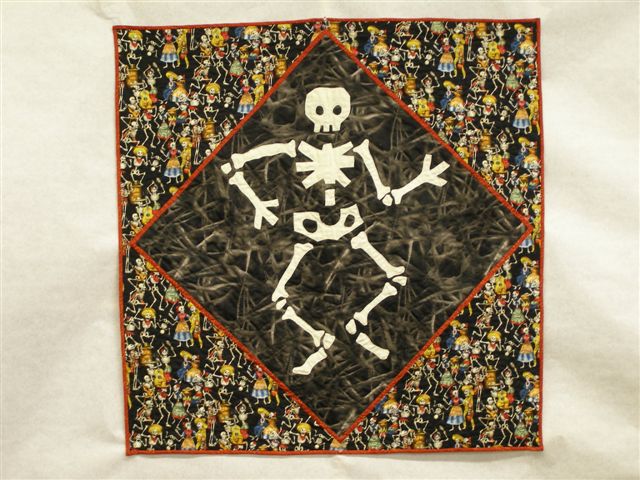
This is one of the quilts in the show called "The Day of the Dead." I've always been fascinated with the imagery surrounding this holiday. Making death less frightening is always a good idea, I believe. Surrounding sadness with food and flowers and putting skeletons in everyday clothes doing normal activities is one of the cleverest ideas ever.